🤖 AI-Powered Credential Attacks: Enterprise Defense Playbook (2026)
In 2023, researchers benchmarked PassGAN, an AI password-generation model, against 15.6 million real-world passwords from the RockYou dataset. It cracked 51% of them in under 60 seconds. That benchmark was not a warning about the future. It described a present threat that enterprise password policies, designed in the 2010s for human-speed attackers, were not built to counter.
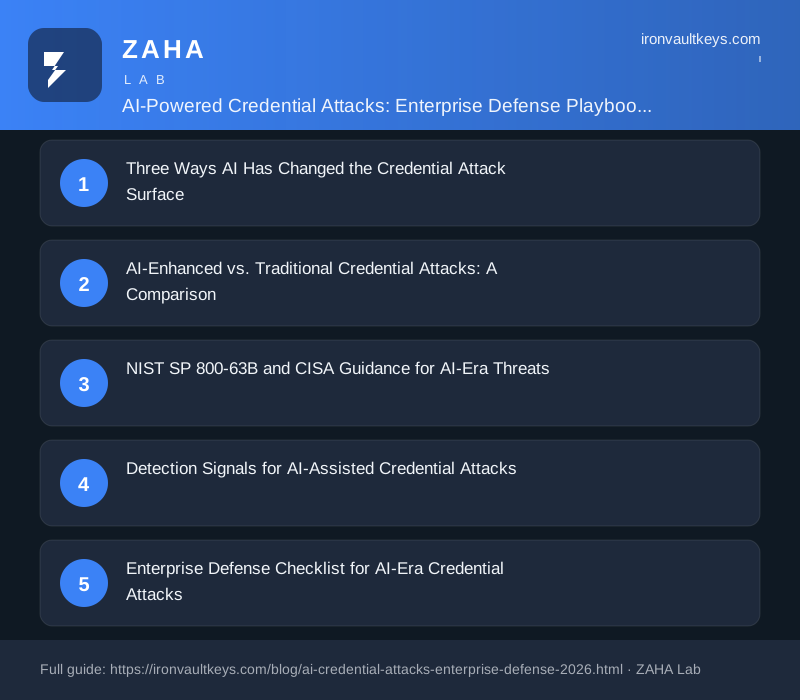
Three Ways AI Has Changed the Credential Attack Surface
1. OSINT-Driven Password Generation
Traditional credential attacks relied on static wordlists: RockYou, SecLists, seasonal-password patterns. A human cracker working manually could spend 40 hours building a custom wordlist for a high-value target by mining LinkedIn, company directories, and social media. AI compresses that to 3 to 5 minutes.
Tools combining LLM prompting with OSINT scrapers now generate personalised candidate password lists that include a target's children's names, birth years, sports teams, employer abbreviations, and previous passwords visible in breach datasets, all ranked by probability. The IBM X-Force Threat Intelligence Index 2024 noted that AI-assisted phishing kit and credential-generation tools had reduced attack preparation time by approximately 80% compared to manual methods.
The practical impact for enterprises: a 12-character password that would take centuries to brute force is trivial to crack if it follows a predictable personal pattern. Emmafc2017! looks complex. An AI trained on breach data and fed a target's publicly known family data will generate it in the first thousand guesses.
2. LLM-Accelerated Phishing and Credential Harvesting
Phishing has always been the fastest path to enterprise credentials. AI made it faster and more convincing. Before LLMs, a spear-phishing email targeting a CFO required a skilled attacker to research the target, draft a convincing email in the right tone, and iterate on pretexts. That took hours. An LLM does it in 90 seconds, producing fluent, contextually specific copy that passes basic text-quality filters.
CISA's 2024 joint advisory on AI-enhanced social engineering (AA24-038A, co-authored with the FBI and NSA) specifically highlighted the use of LLMs to generate phishing lures at scale, noting that "AI-generated content removes many of the grammatical and formatting tells that previously distinguished phishing emails from legitimate correspondence, requiring defenders to shift to link-behaviour and sender-reputation signals rather than content analysis."
The downstream credential risk is direct. AI-polished phishing emails succeed at higher rates. Higher success rates mean more harvested credentials entering the attacker's inventory, increasing the volume available for credential stuffing and direct account takeover.
3. Adaptive Evasion of Behaviour-Based Controls
Security operations teams have invested in machine learning for anomaly detection: UEBA systems that flag unusual login times, geographies, and device patterns. AI-assisted attack tools are starting to study and replicate those "normal" signals.
In documented red-team exercises in 2025, attacker tooling was observed querying target environments to identify typical login windows for an account (pulling Entra ID sign-in logs via a compromised read-only service account), then timing credential stuffing attempts to fall within those windows. The attack mimicked normal user behaviour down to the hour of the day. Static SIEM rules based on time-of-day thresholds did not fire.
This is not widespread in the wild yet. But the tooling exists, and the gap between red-team demonstration and criminal adoption has historically been 18 to 24 months.
AI-Enhanced vs. Traditional Credential Attacks: A Comparison
| Dimension | Traditional Attack | AI-Enhanced Attack |
|---|---|---|
| Wordlist quality | Generic breach compilations (RockYou, COMB) | OSINT-personalised lists ranked by target probability |
| Preparation time | Hours to days for targeted attacks | Minutes with LLM + OSINT pipeline |
| Phishing content | Template-based, detectable grammar errors | Fluent, contextually specific, persona-consistent |
| Detection evasion | Static proxy rotation, fixed timing | Adaptive timing, behaviour mimicry, dynamic proxy selection |
| Skill barrier | Moderate: requires wordlist curation, scripting | Low: LLM prompting replaces manual research |
| Success rate vs. 12-char personal passwords | Low (requires correct pattern guess) | Meaningfully higher when target OSINT is available |
NIST SP 800-63B and CISA Guidance for AI-Era Threats
The 2025 final revision of NIST Special Publication 800-63B addresses AI-assisted attacks more directly than earlier drafts. Section 5.1.1.2 retains and strengthens the requirement to block "context-specific words, such as the name of the service, the username, and derivatives thereof" as passwords. This directly counters OSINT-driven AI password generators that exploit personal context.
The 2025 revision also adds guidance on password length as the primary complexity lever, recommending a minimum of 15 characters for enterprise authenticators and explicitly stating that "complexity rules that require mixed case, numbers, and special characters do not meaningfully increase resistance to AI-assisted guessing when the underlying password follows a predictable pattern." In short: Emmafc2017! fails NIST 2025, regardless of its apparent complexity.
According to NIST SP 800-63B (2025 final), Section 5.1.1.2: "Verifiers and CSPs SHALL NOT impose other composition rules (e.g., requiring mixtures of different character types or prohibiting consecutively repeated characters) for memorized secrets." The standard treats length and breach-list exclusion as the two controls that actually work, not arbitrary complexity rules.
CISA's Identity and Access Management Recommended Best Practices Guide (2023) recommends that organisations treat AI-enhanced phishing as a baseline threat assumption, not a future scenario, and calls for phishing-resistant MFA (FIDO2, hardware tokens) as the minimum control for any account with access to sensitive data.
Detection Signals for AI-Assisted Credential Attacks
AI-assisted attacks are harder to detect than volumetric brute force. The signals are subtler and require cross-account correlation rather than per-account thresholds. The following indicators should be built into SIEM and identity-provider monitoring:
| Signal | What It Indicates | Detection Approach |
|---|---|---|
| High-entropy password failure pattern | Attacker testing personalised guesses, not generic wordlists | Log failed password attempts where attempted values are structurally similar to the target's known personal data |
| Phishing link click from uncommon device | AI-polished phishing email reached an employee | Email gateway + browser fingerprinting integration; flag link clicks from devices not previously seen for that account |
| Login timing mimicry | Automated attack studying and replicating normal login windows | Device fingerprint mismatch during a login that falls within the user's normal time window; TLS fingerprint inconsistent with claimed browser |
| Successful login from known proxy ASN | AI-driven stuffing tool using residential proxies | Enrich sign-in logs with ASN data; alert on successful authentications from residential proxy providers (Bright Data, Smartproxy ASN ranges) |
| Rapid MFA prompt response | Possible real-time phishing relay (attacker proxying session live) | Flag MFA approvals completed in under 5 seconds of prompt; flag approvals from a different device than the initiating login |
| Credential reuse across SaaS platforms | Employee reusing a password that appeared in a breach | Integrate HaveIBeenPwned k-anonymity API at authentication; alert when a submitted password matches a known breach hash |
Enterprise Defense Checklist for AI-Era Credential Attacks
Layer 1: Eliminate Predictable Password Patterns
- Enforce a minimum password length of 15 characters (NIST SP 800-63B 2025 recommendation)
- Block context-specific passwords: company name, username, service name, and all common variants
- Block personal-context patterns using a configurable deny list that includes common name formats, birth years (1960-2015), and sports team names
- Screen all new and reset passwords against the HaveIBeenPwned k-anonymity API or an on-premises breach corpus
- Remove complexity rules that require mixed case and special characters without also requiring length (complexity rules do not address AI-personalised guessing)
Layer 2: Phishing-Resistant Authentication
- Deploy FIDO2/passkeys for all privileged accounts: admin, finance, HR, executive assistants
- Enforce hardware security keys (YubiKey or equivalent) for accounts with access to cloud consoles and production environments
- Replace SMS and email OTP with app-based TOTP or push MFA as a minimum for all accounts
- Enable number matching and additional context (location, application name) on all push-based MFA prompts to counter AI-assisted MFA fatigue
Layer 3: AI-Aware Detection Rules
- Build SIEM correlation rules that look for TLS fingerprint mismatches between claimed user-agent and actual TLS hello during authentication
- Alert on successful logins from residential proxy ASNs (not just known malicious IPs)
- Flag MFA approvals completed under 5 seconds of the prompt being issued
- Integrate dark web monitoring to receive early warning when employee credentials surface in AI-aggregated breach compilations
Layer 4: Workforce Training Calibrated to AI Phishing
- Update phishing simulation content quarterly with LLM-generated samples, not templates from 2020
- Train employees to evaluate link destination and sender domain, not email writing quality (AI-polished phishing passes grammar checks)
- Run tabletop exercises that include AI-assisted spear-phishing scenarios targeting specific roles (CFO, IT admin, HR director)
- Establish a clear, low-friction reporting channel so employees report suspicious emails before clicking
For enterprises managing the credential hygiene layer at scale, an enterprise password manager handles the most time-consuming controls automatically. NordPass Business generates high-entropy unique passwords for every service, screens stored credentials against breach databases, and integrates with Active Directory and SSO platforms. Employees cannot reuse passwords or choose personal-context ones when a password manager fills credentials automatically, removing the OSINT-predictability problem at its source.
FAQs
What is an AI-powered credential attack?
An AI-powered credential attack is an identity-based attack in which the adversary uses machine learning or generative AI to improve password guessing accuracy, generate convincing phishing content at machine speed, or adapt attack timing to evade behaviour-based controls. The core advantage over traditional attacks is reduced preparation time and higher personalisation, making previously "complex" passwords vulnerable if they follow predictable personal patterns.
Does a 15-character password protect against AI password cracking?
Length is the most effective single defence, but only if the password avoids predictable personal patterns. A 15-character passphrase containing a pet's name, a birth year, and a symbol is still vulnerable to an AI generator trained on OSINT about that individual. A 15-character random string generated by a password manager is not. NIST SP 800-63B 2025 explicitly recommends length and breach-list exclusion over complexity rules precisely because AI guessing exploits patterns, not entropy alone.
How do AI-polished phishing emails differ from traditional ones?
Traditional phishing emails often contained grammar errors, odd formatting, and generic pretexts that security-aware employees could identify. LLM-generated phishing produces fluent, contextually specific content written in the target's expected register (formal for a legal team, casual for a marketing team), referencing real internal projects or recent company news scraped from LinkedIn. CISA's AA24-038A advisory notes that content-quality analysis is no longer a reliable filter; defenders need to focus on link behaviour and sender domain reputation instead.
Will FIDO2 passkeys stop AI-enhanced credential attacks?
FIDO2 passkeys are the most effective control currently available against AI-assisted credential attacks. They are phishing-resistant by design: the cryptographic challenge is bound to the exact origin of the authentication request, so a phishing proxy that harvests a session token cannot relay a valid passkey response. They also eliminate the password entirely for enrolled services, removing the OSINT-guessable password from the attack surface. CISA's 2023 IAM Best Practices Guide designates FIDO2 as the recommended minimum for privileged accounts in all sectors.
How quickly are AI credential attack tools becoming accessible to low-skill attackers?
The IBM X-Force 2024 report documented AI-assisted attack tools circulating in threat actor forums as early as late 2023, priced between $20 and $200 per month as subscription services. The skill barrier for executing an OSINT-informed credential attack dropped significantly: tasks that previously required Python scripting and manual research are now menu-driven. The IBM report estimated an 80% reduction in attack preparation time across surveyed incidents involving AI-assisted tools. The trajectory suggests that AI-enhanced credential attacks will be a commodity-level threat by 2027, not a nation-state-exclusive technique.