📦 Credential Stuffing Attacks: Enterprise Detection and Prevention (2026)
The RockYou2024 compilation, released in July 2024, contained 9.9 billion unique plaintext passwords scraped from decades of data breaches. Automated bots can now test those credentials against your enterprise login pages at thousands of attempts per minute without triggering a single brute-force lockout. Credential stuffing is why password reuse is no longer a personal risk, it is a direct threat to your organisation's production systems, even if your own infrastructure has never been breached.
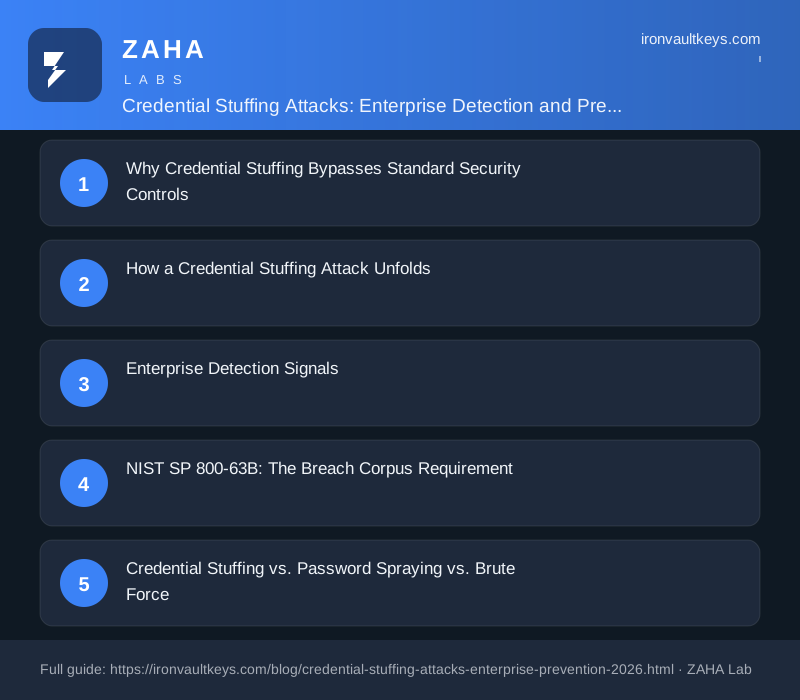
Why Credential Stuffing Bypasses Standard Security Controls
Traditional brute-force lockout policies, block after N failed attempts, require CAPTCHA, lock the account for 30 minutes, are calibrated to stop an attacker guessing random password combinations. Credential stuffing breaks that model entirely.
In a stuffing campaign, an attacker with a 10-million-record breach dataset does not need to guess. They already have a password that worked somewhere. Research consistently shows that between 0.1% and 2% of credentials in a typical breach dataset will succeed against any given target service, because of password reuse. Against a platform with 500,000 accounts, that translates to 500 to 10,000 valid account takeovers from a single credential list, without triggering a single unusual pattern per individual account.
Standard controls fail because:
- Per-account lockout only fires after multiple failures for the same account. Stuffing usually makes one or two attempts per account across millions of accounts, never exceeding the threshold.
- IP-based rate limiting is defeated by residential proxy networks, which rotate through millions of real home IP addresses, each appearing to make only one or two requests.
- CAPTCHA is bypassed by automated CAPTCHA-solving services costing fractions of a penny per solve, or by using proxies that route through humans completing CAPTCHAs as a side income.
According to OWASP's Automated Threat Handbook (2023 edition), credential stuffing (OAT-008) is distinct from brute force (OAT-007) precisely because "the attacker already has evidence that the username/password combination is valid somewhere, and is testing whether it is reused." OWASP notes that standard WAF rules and rate limiting are insufficient without additional behavioural signals.
How a Credential Stuffing Attack Unfolds
- Credential acquisition: The attacker purchases or downloads breach databases from dark-web markets or public repositories. Compilations like COMB (Compilation of Many Breaches), Collection #1, and RockYou2024 aggregate billions of records from hundreds of prior incidents. Many of these are available for free.
- Tool setup: Dedicated tools, Sentry MBA, STORM, BlackBullet, Openbullet, automate the login process and accept configuration files ("configs") tailored to the target website's login form structure. These are sold openly in threat actor forums.
- Proxy rotation: Attackers route requests through rotating proxy pools (often residential proxies harvested from malware-infected consumer devices) to distribute source IP addresses and evade rate limiting.
- Silent testing: The attack runs quietly, making one or two attempts per account, over hours or days. Successful logins are flagged automatically; the attacker reviews the results and acts on high-value accounts (admin, finance, HR).
- Monetisation or lateral movement: In consumer applications, successful accounts are sold or used for fraud. In enterprise environments, the goal is often lateral movement, using an employee's account to access internal systems, VPNs, SaaS platforms, and cloud consoles.
Enterprise Detection Signals
Credential stuffing is detectable, it just requires looking at signals across accounts rather than within a single account. The following table covers the key indicators to build into your SIEM rules and authentication monitoring:
| Signal | What to Measure | Alert Threshold |
|---|---|---|
| Login failure rate spike | Global failed authentications per minute across all accounts | >3× baseline for 5 minutes |
| Distributed failure pattern | Failed logins spread across >N distinct accounts from a single IP or ASN | >50 unique accounts per IP per hour |
| User-agent homogeneity | High proportion of login attempts using identical or near-identical user-agent strings | >80% same UA during spike |
| Residential proxy ASN concentration | Logins originating from known residential proxy ASNs (e.g. Luminati/Bright Data) | Any meaningful volume from flagged ASNs |
| Velocity without session depth | Login attempt made with no prior page views (direct POST to auth endpoint) | High ratio of headless requests to normal browser flows |
| TLS fingerprint anomaly | JA3/JA3S TLS fingerprints inconsistent with claimed user-agent | Mismatch between UA and TLS fingerprint |
| Unusual geography for account | Successful login from a country the account has never logged in from | New country + first login in period |
None of these signals is reliable in isolation. A single residential-proxy login is not inherently malicious. The value lies in combining signals: a spike in failed logins, from distributed IPs, with homogeneous user-agents, targeting the direct authentication endpoint, that pattern is a credential stuffing campaign with high confidence.
NIST SP 800-63B: The Breach Corpus Requirement
NIST Special Publication 800-63B, Section 5.1.1.2, requires that organisations operating authenticators compare new and reset passwords against a corpus of known compromised credentials at the point of creation and change. The 2025 final version reinforces this: verifiers "SHALL compare the prospective secrets against a list that contains values known to be commonly-used, expected, or compromised."
This is a direct mitigation for credential stuffing. If an employee's chosen password already appears in a breach database, no amount of attacker effort is needed to obtain it, it can be downloaded for free. Blocking the use of breached credentials at account creation and password reset removes the low-hanging fruit that credential stuffing relies on.
Practical implementation requires:
- Integration with a compromised password API (HaveIBeenPwned's k-anonymity API, or an on-premises blocklist from NCSC's Top 100,000 Passwords list)
- Checking at every authentication event, not just at password creation, if your architecture permits it
- A human-readable rejection message that explains why the password was rejected (NIST-aligned: "this password has appeared in a data breach, please choose a different one")
For enterprises managing large employee populations, an enterprise password manager like NordPass Business handles breach monitoring automatically, alerting users and administrators when any stored credential appears in a known breach database, without requiring employees to check manually.
Credential Stuffing vs. Password Spraying vs. Brute Force
These three attacks are frequently conflated. The distinctions matter for detection and response:
| Attack | Credential Source | Attempts per Account | Lockout Risk | Primary Defence |
|---|---|---|---|---|
| Credential Stuffing | Prior breach database | 1–2 (real credentials) | Low, stays under threshold | Breached-password screening, MFA, bot detection |
| Password Spraying | Common passwords (e.g. Season+Year) | 1 per target per spray round | Low, one attempt per account per cycle | NIST-aligned blocklists, MFA, Entra Smart Lockout |
| Brute Force | Algorithmically generated | Unlimited (sequential) | High, triggers lockout quickly | Lockout policy, rate limiting, account lockout |
All three attacks are neutralised by MFA, but not completely. Credential stuffing in enterprise environments sometimes targets legacy systems, VPNs, and remote desktop portals that predate MFA requirements or cannot enforce it easily. Those endpoints are the highest-risk exposure surface for stuffing campaigns.
Enterprise Prevention: A Layered Defence Checklist
Layer 1: Authentication Controls
- Enforce MFA on all external-facing authentication endpoints, VPN, SSO, webmail, cloud consoles
- Implement FIDO2/passkeys for privileged accounts (admin, finance, HR) where possible
- Enable Smart Lockout (Microsoft Entra) or equivalent adaptive lockout on your identity provider
- Deploy risk-based authentication that challenges logins from new geographies, devices, or IP ranges
Layer 2: Credential Hygiene
- Integrate HaveIBeenPwned k-anonymity API or NCSC's compromised password list at password creation and reset
- Enforce a minimum password length of 15 characters (NIST SP 800-63B 2025 recommended minimum for enterprise)
- Block known weak patterns: season+year formats, company name variants, keyboard walks
- Deploy an enterprise password manager to eliminate reuse across personal and work accounts
Layer 3: Bot and Traffic Controls
- Enable bot management on your authentication endpoints (Cloudflare Bot Management, AWS WAF Bot Control, or equivalent)
- Implement device fingerprinting to distinguish browser sessions from headless automation
- Rate-limit at the organisational/ASN level, not just per-IP, residential proxy pools make per-IP limiting insufficient
- Monitor for TLS fingerprint anomalies (JA3/JA3S mismatches between claimed user-agent and actual TLS hello)
Layer 4: Detection and Response
- Build SIEM correlation rules for global failed-login spikes across multiple accounts (not per-account thresholds)
- Alert on successful logins from new countries or ASNs for accounts with no travel history
- Establish a playbook for rapid credential rotation when stuffing is detected, assume all accounts targeted during the campaign may be compromised
- Integrate dark web breach monitoring to receive early warning when your organisation's credentials appear in compilations
According to CISA's Identity and Access Management Recommended Best Practices Guide (2023), organisations should treat credential stuffing as a "known, persistent threat" and note that "the availability of large credential datasets means that any internet-facing authentication system without MFA and bot controls should be considered at risk."
Real-World Credential Stuffing Incidents
Credential stuffing is not theoretical. Several high-profile enterprise incidents in recent years trace directly to breach database exploitation:
- Okta (2022): The Lapsus$ group obtained credentials for an Okta support engineer, enabling access to customer tenants. While the initial vector involved insider access, subsequent analysis showed that exposed contractor credentials were circulating in breach compilations before the incident.
- Snowflake customer breach cluster (2024): Mandiant attributed a wave of Snowflake customer account compromises to credential stuffing, attackers used stolen credentials sourced from infostealer malware infections and prior breach databases against Snowflake instances that lacked MFA enforcement. Over 100 organisations were affected.
- 23andMe (2023): Attackers used credential stuffing to access approximately 14,000 accounts directly, then leveraged 23andMe's DNA Relatives feature to extract data from a further 6.9 million profiles. The attack used credentials from other breaches, 23andMe's own infrastructure was not compromised.
The 23andMe incident is instructive: even when your infrastructure is secure, credential stuffing lets attackers walk in through your legitimate login door using passwords your users chose elsewhere.
The Role of Enterprise Password Management
The most durable fix for credential stuffing risk in a workforce is eliminating password reuse at its source. Enterprise password managers accomplish this by generating unique, high-entropy credentials for every service and storing them in an encrypted vault that synchronises across devices.
When employees cannot reuse passwords, because the password manager generates and fills them automatically, a breach at any third-party service yields credentials that work nowhere else. Even a credential dataset containing an employee's exact password for LinkedIn is useless against your enterprise VPN if that password is unique.
NordPass Business includes built-in breach monitoring, zero-knowledge architecture, and Active Directory integration for enforcing password policies at scale, covering both the credential hygiene and detection aspects of a credential stuffing defence in a single deployment. For teams running compliance frameworks that require demonstrable password controls (SOC 2, ISO 27001, HIPAA), a managed password solution also provides the audit trails needed to evidence control effectiveness.
FAQs
What is credential stuffing?
Credential stuffing is an automated account takeover attack that uses username and password pairs obtained from previous data breaches to attempt logins at other services. It exploits password reuse, the fact that many people set the same password across multiple accounts. OWASP classifies it as Automated Threat OAT-008.
How is credential stuffing different from a brute-force attack?
Brute force generates password guesses algorithmically and makes many attempts per account, triggering lockout policies quickly. Credential stuffing uses real, previously valid credentials and typically makes only one or two attempts per account, staying well under lockout thresholds while succeeding at a meaningful rate due to password reuse.
Does MFA stop credential stuffing?
MFA stops most credential stuffing attacks, if a stolen password is used, the attacker still needs the second factor. However, credential stuffing against legacy endpoints that lack MFA (old VPNs, RDP portals, mail servers) remains a serious risk. Additionally, attackers combine credential stuffing with MFA fatigue attacks on push-based MFA systems. See our MFA fatigue attack guide for the full picture.
How do I check if my organisation's credentials are in breach databases?
Use HaveIBeenPwned's domain search feature to check whether email addresses at your domain appear in known breaches. For ongoing monitoring, enterprise dark web monitoring services (included in platforms like NordPass Business) alert you automatically when employee credentials surface in new breach compilations.
What does NIST SP 800-63B say about credential stuffing?
NIST SP 800-63B Section 5.1.1.2 requires that verifiers compare prospective passwords against a corpus of compromised credentials at creation and change time. The 2025 final version of the standard strengthens this requirement and recommends that verifiers also check credentials against breach lists during authentication risk scoring. This directly targets the password-reuse vector that makes credential stuffing effective.
Can credential stuffing attacks be detected in SIEM?
Yes, with the right correlation rules. The key is to shift from per-account thresholds to cross-account patterns: a spike in total failed logins distributed across many accounts from distributed IPs, with homogeneous user-agents, is a strong indicator. See the detection signals table earlier in this guide for the full set of indicators to build into your alert logic.